- Edition
- Fifth
- Date
- Saturday, 14 February 2026
- Venue
- Kothari Hall, Bangalore
- Running time
- 1:47:17
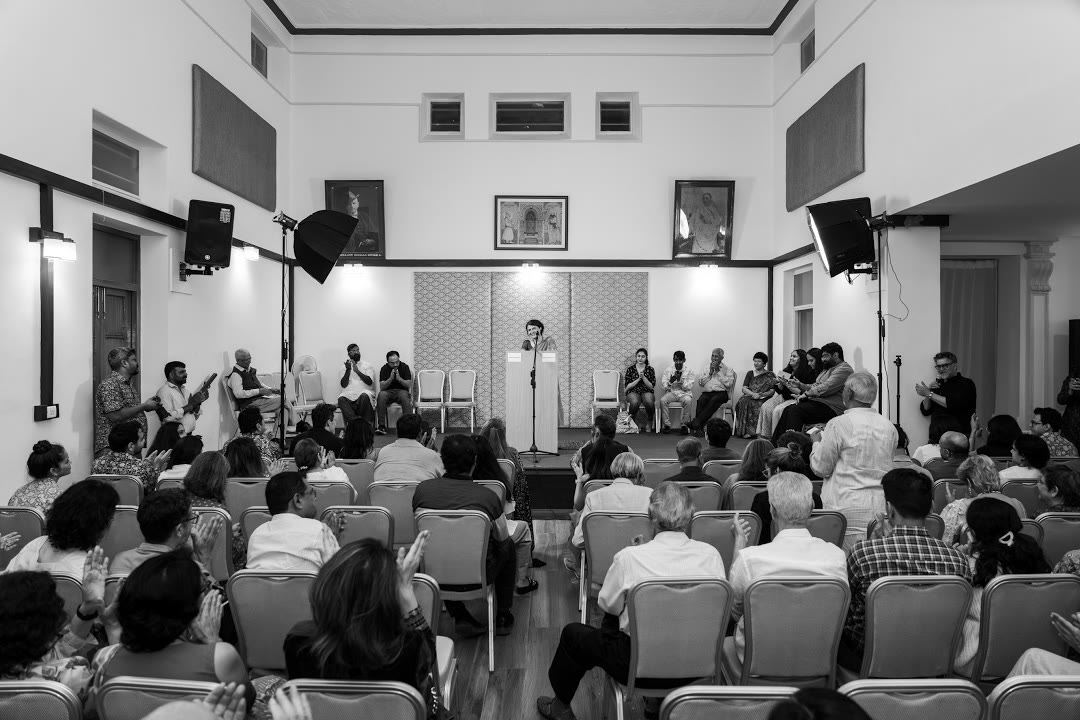
Recorded live at Kothari HallWatch on YouTube ↗
The lecture
On Valentine’s Day 2026 the fifth lecture became, in Aditya Sondhi’s words, a love letter to the city. Aliyeh Rizvi, a place-based storyteller and memory archivist, began with loss. She remembered a childhood city erased by excavators and the internet boom, and asked whether old Bangaloreans’ endless reminiscing might be a form of grief. From there she rebuilt belonging out of the stories she had gathered. She spoke of a multilingual ease and a calendar kept by flowering trees. She took in Mysore rockets and the Bangalore torpedo, pubs and puffs, horses and bookshops, and the small courtesy of “sir” that keeps the city moving. A city of brick can be pulled down, she argued, but one built of memory is far harder to demolish.
In six movements
What was said
Displaced in place
Rizvi had written about the Tibetan settlement at Bylakuppe and the Sindhi Colony in Cox Town. Then she realised that she, too, had lost a home without leaving it. “I’m not anti-change. I just want to have a say in what happens to my city.”
The art of lingering
She described the lost arts of lingering, loafing and loitering. The city speaks when we are quiet and still, she said, and people offer their memories as gifts.
A plural city
Bangalore’s identity is many-layered. She quoted one resident who spoke Tamil with Tamilians, Telugu with Telugus and English with Kannadigas. Bangalore, she said, “is loving bisi bele bath as much as beef fry.”
Silk, rockets and science
The talk ran from the cotton of the Pete and the woollens of Binny Mills to Tipu’s rocket works and the Bangalore torpedo of 1912. In 1905 Bangalore became the first Indian city lit by electricity, and IISc, HAL and ISRO followed.
The garden city
She described the city’s calendar of flowering trees: pink tabebuia at Christmas, yellow tabebuia at exam time, gulmohur when school reopens. She spoke too of bungalows, lakes, the Karaga, and Bangalore Red roses at the Hebbal flower auction.
A city with a heart
Bangalore has a long tradition of philanthropy, of beer and Iyengar bakeries, and of rock bands and bookshops. And there is the small word “sir”, a currency of respect “regardless of your bank balance.”
In their words
“I’m not anti-change. I just want to have a say in what happens to my city.”
“It’s always amazing to see how the city speaks when we are quiet and still.”
“Bangalore’s identity is not a singular one. It is the outcome of many layers of interactions between people and place.”
The speaker
Aliyeh Rizvi is a place-based storyteller, history writer and memory archivist. She founded Native Place, a studio for historical storytelling about the city, and co-founded the Memory Maps project. She writes a weekly local-history column for Bangalore Mirror and sits on the Bangalore Tourism Advisory Committee. Born in Bangalore, she counts Sir Mirza Ismail among her forebears.